 Label
Product information
Men's Health Supplements: How to Judge Any Label in Ten Minutes
To judge a supplement label, check the serving and count, each ingredient in milligrams, whether an amount is an extract and at what ratio, the directions and warnings, and the maker. Then compare each amount with what studies used. Most men's formulas are strong on words and weak on doses.
Written by the HoneyBoost label deskUpdated
Why read the label at all?
Because the front is marketing and the panel is the product.
In the U.S., FDA treats dietary supplements as a kind of food, not a drug. FDA does not approve a supplement before it is sold, and the maker is responsible for safety and for truthful labeling (FDA, FDA 101: Dietary Supplements). A structure or function claim is allowed if the label also says FDA has not evaluated it and that the product is not meant to treat, cure or prevent disease (FDA, Structure/Function Claims).
To read any supplement label, check five things. First the serving size and the count. Second each active amount in milligrams. Third whether an amount is a plant extract and which ratio. Fourth the directions and warnings. Fifth the maker's name and phone. HoneyBoost's label gives the first three and the fifth in part, but no directions.
What are the steps?
Seven checks, in order.
| Step | What to look for | Example from HoneyBoost |
|---|---|---|
| Serving and count | Size of one serving and servings per container | 1 gummy (4.2 g), 30 servings |
| Amounts | Milligrams for every active line | Zinc 2.5 mg, tongkat ali 25 mg, others 10 mg |
| Form of each | Extract ratio, species, part of plant | 10:1, 8:1, 5:1, 100:1; horny goat weed species not named |
| Daily Value | Where one exists | Zinc 23%; others not established |
| Directions | How much, how often | None printed on the label we have |
| Warnings | Who should not take it | Pregnancy, medical condition, other medications |
| Maker and contact | A named company and a working phone | Distributor named; maker not named |
How do you compare to studies?
Look up the studied dose, and divide.
Dose is the whole story in supplement research. A plant can show an effect at 2,400 mg a day and nothing at 10 mg. Before you accept a claim, ask what amount the study used and compare it to the amount on the label. The dose ruler on this site does that comparison for each ingredient.
A ratio such as 10:1 or 100:1 says how much raw plant went into the extract. It is a recipe, not a measure of strength. Two 10:1 maca extracts can differ in what they hold. That is why studies name a standardized extract, and why a label that prints only a ratio cannot be matched to a trial.
Which claims should worry you?
Words that sound like a drug effect, or a promise.
Three lines you will not find here: "clinically proven," "FDA approved" and "results in X days." No trial tested HoneyBoost, FDA does not approve supplements before sale (FDA, FDA 101: Dietary Supplements), and the label gives no timeline. The FTC expects health claims to rest on competent and reliable scientific evidence, usually human trials of the same product (FTC, Health Products Compliance Guidance).
Several front phrases end with a dagger (†): INTENSE STRENGTH†, PEAK STAMINA†, PERFORMANCE SUPPORT† and BIGGER DRIVE. HARDER. LONGER.† The dagger points to a box on the left of the label: "These Statements have not been evaluated by the FDA. This product is not intended to diagnose, treat, cure, or prevent any disease." That box is the standard disclaimer that supplement makers must print next to structure and function claims (FDA, Structure/Function Claims).
What about stamina supplements for athletes?
Stamina is a hard thing to measure, and most labels do not try.
Athletes search for stamina supplements for running, cycling and the gym. The best-supported aids are plain: sleep, food, training and, for some, caffeine or creatine under a coach's advice. A herbal blend with a stamina phrase rarely cites a trial of stamina. HoneyBoost's front says PEAK STAMINA†, and the dagger points to the FDA disclaimer. Athletes in tested sports should also know that supplements can contain banned substances not on the label, and the rules usually put the responsibility on the athlete.
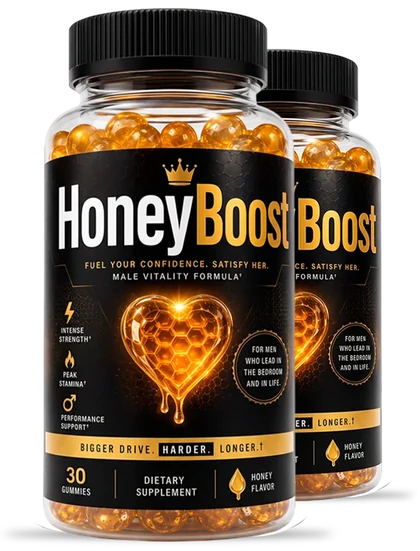
HoneyBoost: 30 gummies a bottlePacks of 2, 3 or 6 bottles · confirm the price at checkout · 60-day money-back (confirm live policy)
See packsWhat about mental stamina and focus?
Same rules: look for a study of the same dose.
Mental energy claims tend to cite caffeine, B vitamins or herbs. HoneyBoost lists no caffeine and no B vitamins. Its label says nothing about focus beyond the word confidence in a tagline. If tiredness or poor focus is a problem, a clinician can look at sleep, mood, thyroid, anemia and medicines. A supplement is the last step, not the first.
Trouble with erections, low desire or ongoing tiredness can come from heart and blood vessel disease, diabetes, medicines, stress, poor sleep, low testosterone and other things. NIDDK lists many causes and says a health care professional should look at the whole picture (NIDDK, Erectile Dysfunction: Symptoms and Causes). A gummy does not tell you which cause you have. Getting checked is the part that can help.
Can you score a label?
A simple score helps you compare two products on the same terms.
| Question | Point if yes |
|---|---|
| Every active line has an amount in mg | 1 |
| Each plant is named by species and part | 1 |
| Extracts give a ratio or a marker percentage | 1 |
| Directions are printed | 1 |
| Warnings are printed | 1 |
| The maker is named | 1 |
| A lot code is printed | 1 |
| A lab report is available on request | 1 |
| The claims name no disease | 1 |
| The amounts are within a studied range | 1 |
Score HoneyBoost with the label we have and you get about 4 of 10: credit for amounts, ratios, warnings and for naming no disease, and none for directions, species, maker, lot code, lab report or studied amounts. Do the same for any product you are weighing, and be as strict with the one you like as with the one you do not. A score is not a verdict. It is a way to stop a shiny front from deciding for you.
How do you stay safe?
Ask, test and track.
A short list of who should ask first: people on nitrates or other heart medicine, on blood pressure medicine, on ED drugs, on MAO inhibitors or Parkinson medicine, on diabetes medicine (damiana may affect blood sugar), on aromatase inhibitors or other hormone or cancer medicine, and on tetracycline or quinolone antibiotics (zinc can lower their absorption). People with heart disease, a hormone-sensitive condition, or a psychiatric condition should ask as well.
Hidden drugs are the best documented risk in this product category. An FDA laboratory found that 15 of 26 herbal products sold for "sexual performance" held undeclared ED drugs or close copies of them (Gryniewicz et al. 2009). FDA keeps a public list of tainted sexual enhancement products and says the list is not complete (FDA, Sexual Enhancement and Energy Product Notifications). We have no test showing that HoneyBoost holds anything beyond its label. We also cannot rule it out, and no review site can.
If something goes wrong, tell your clinician first, keep the bottle and its lot code, and report the event to FDA at MedWatch (FDA, MedWatch). A report helps FDA spot patterns, such as hidden drugs, that a single buyer cannot see. Also tell the seller, whose order desk number is on the contact page.
FAQ01
HoneyBoost questions people ask
How do I read a supplement label?
Check the serving, the milligrams of each line, the extract ratios, the directions and the maker.
Does a Daily Value of not established mean it is not safe?
No. It means no reference amount has been set.
What does 10:1 mean?
Ten parts of plant went into one part of extract.
Are stamina supplements proven?
Few have a trial of stamina. Check the study dose.
Can a label be wrong?
Yes. FDA does not test supplements before sale.
Should I tell my doctor?
Yes, about every supplement.
Who wrote this02
Written and reviewed by
Pages built from the label images, seller information and linked NIH, FDA, CDC, FTC and peer-reviewed sources.
Last updated . Read our editorial standards and how we check reviews. This website is the information site for a U.S. authorized retailer (a licensed U.S. retail desk) for HoneyBoost. It is not the manufacturer or the distributor named on the label. We earn money when you buy through our order links.
Keep reading
More about HoneyBoost
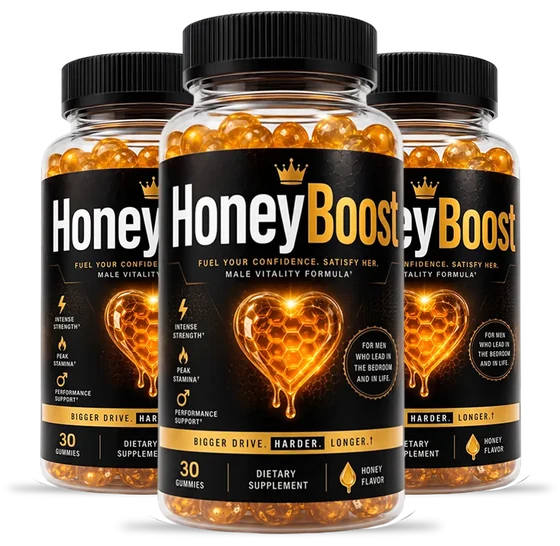
Licensed U.S. retail desk for HoneyBoost
Ready to look at HoneyBoost?
Check your medicines first, read the directions on the bottle that arrives, then pick a pack of 2, 3 or 6 bottles. The checkout shows the live price, any shipping and the guarantee.
- Checkout runs on the sales site
- 60-day money-back (confirm live policy)
- Ships from the U.S.